Skip to content
RNJ.TradingHome

Pool Sanitiser

Calcium Hypochlorite 65–70% Granular

Unstabilised chlorine at 65–70% available chlorine, in granular and tablet form, sodium and calcium process.

Ca(ClO)₂

  • CAS7778-54-3
  • HS code2828.10
  • UNUN 1748

About Calcium Hypochlorite

Calcium hypochlorite is an unstabilised chlorine donor used in pool and water treatment. It contains no cyanuric acid and its solution is alkaline. Supplied in sodium-process and calcium-process grades, as granules or tablets, in drums and pails.

Appearance
White to off-white granule or tablet, strong chlorine odour

Safety data sheets and batch documentation are issued against the material supplied rather than hosted as generic PDFs. Tell us the grade and we will send the current documents.
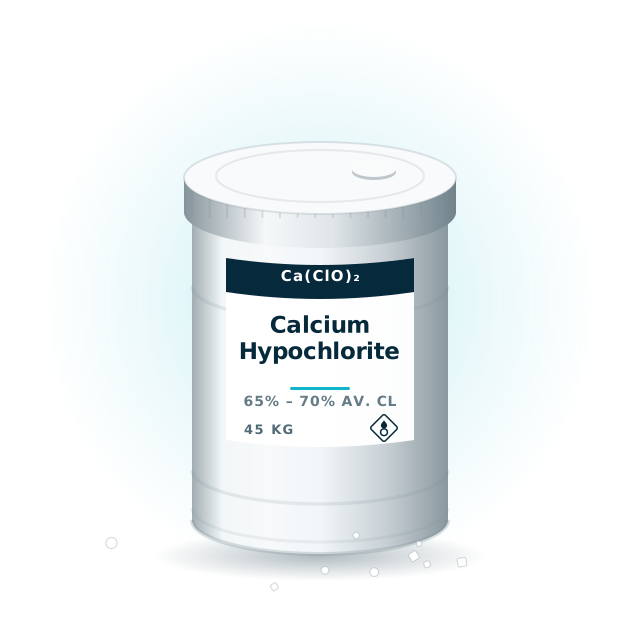
Calcium Hypochlorite — White to off-white granule or tablet, strong chlorine odour, supplied by RNJ Trading in 45 kg HDPE drum

Illustrative artwork. Packaging and labelling vary by grade and private-label requirement.

Technical data

Calcium Hypochlorite specifications

Typical values for this grade, published so you can identify the product. They are not a specification guarantee — the batch documentation issued with your consignment is the document that governs what you receive.

Technical specification of Calcium Hypochlorite 65–70% Granular, CAS 7778-54-3.
ParameterValue
Available chlorine65% – 70%
Moisture5.5% – 10%
pH (1% solution)10.4 – 11.8
Particle size14–50 mesh granular
Insolubles3% max (sodium process)
Shelf life12 months, sealed, below 30 °C

Grades available

  • Sodium process 65–70%
  • Calcium process 65%
  • 200 g tablets

Packaging

  • 45 kg HDPE drum
  • 50 kg HDPE drum
  • 5 kg / 10 kg pails

Where Calcium Hypochlorite is used

  • Pool treatment and remediation
  • Potable water and reservoir disinfection
  • Cooling water and effluent disinfection
  • Food-industry surface sanitation

Handling & storage

A strong oxidiser. Store below 30 °C, dry, away from acids, organics, oils and all other chlorine products. Never mix with TCCA or SDIC. Keep containers sealed — absorbed moisture generates heat and chlorine gas. Refer to the safety data sheet before handling or use.

This summary does not replace the safety data sheet. Read the current SDS in full, use the personal protective equipment it specifies, and comply with UAE Civil Defence and local authority requirements for chemical storage.

Frequently asked

Questions we get about Calcium Hypochlorite

What does RNJ Trading supply?
Swimming pool and water treatment chemicals. The range covers chlorine sanitisers — SDIC granules and tablets, TCCA 90, calcium hypochlorite and sodium hypochlorite — alongside pH and alkalinity correctors, a coagulant for water clarity, and cyanuric acid stabiliser. Everything is available in pail, drum and bulk-bag formats. The full list, with grades and pack sizes, is on the products page.
What is the difference between SDIC, TCCA and calcium hypochlorite?
They are three different chlorine chemistries. SDIC and TCCA are chlorinated isocyanurates and are stabilised, meaning they contain cyanurate; calcium hypochlorite is unstabilised and contains calcium instead. They differ in available chlorine, in how quickly they dissolve and in whether their solution is acidic or alkaline — the typical values for each are published on its product page. Which one suits a given installation is a decision for the person responsible for that water system.
What grades and pack sizes are available?
SDIC granules and tablets are supplied in 5 kg and 10 kg pails, 25 kg and 50 kg HDPE drums and 1,000 kg jumbo bags. TCCA 90 comes in pails and 25 kg and 50 kg drums. Calcium hypochlorite comes in 45 kg and 50 kg drums and in pails. The pH range — sodium bisulphate, sodium bicarbonate and soda ash — comes in 25 kg and 50 kg bags and jumbo bags. Sodium hypochlorite is supplied in cans, drums, IBCs and bulk.
Can different chlorine products be mixed?
No. Chlorinated isocyanurates such as SDIC and TCCA must never be combined with calcium hypochlorite, and none of them should come into contact with acids, ammonium compounds, oils or organic material. Mixing can cause fire and the release of chlorine gas. Store each chemistry separately, use dedicated dry equipment for each, and follow the segregation instructions in the safety data sheet.

Also in the range

Other products in the range

Sanitiser, pH correction and clarity products are usually bought together. These lines can go on the same enquiry as Calcium Hypochlorite.

  • SDIC Granular packagingBest seller

    SDIC Granular

    C₃Cl₂N₃NaO₃

    Stabilised chlorine granule in 56% and 60% available-chlorine grades, supplied in pails, drums and jumbo bags.
    • Available chlorine56% min / 60% min
    • Moisture3.0% max
  • SDIC Tablets packagingBest seller

    SDIC Tablets

    C₃Cl₂N₃NaO₃

    The same SDIC chemistry pressed into fixed-weight tablets, from 1 g effervescent up to 200 g slow-dissolve.
    • Available chlorine56% min / 60% min
    • Tablet weights1 g, 3.3 g, 4 g, 20 g, 150 g, 200 g
  • TCCA 90 packagingCore line

    TCCA 90

    C₃Cl₃N₃O₃

    Stabilised chlorine at 90% available chlorine, in 20 g and 200 g tablets, granular and powder.

    • Available chlorine90% min
    • Moisture0.5% max

Ready when you are

Tell us what you needand we’ll price it.

SDIC granules and tablets, TCCA 90, calcium hypochlorite, sodium hypochlorite, pH correctors, clarifier and stabiliser — in pails, drums, bags and bulk. Send the products, grades and quantities and we will come back with a written quotation.

Written quotation, no obligationPriced to your grade and pack sizeUAE delivery and GCC export quoted

Prefer email? sales@rnjtrd.com · Sat – Thu, 8:00 AM – 6:00 PM (GST)